

![图片[1]-脑子停不下来怎么办?道家哲学给你的解药-心智夜航](https://xzyh.top/wp-content/uploads/2026/07/xzyh-ed09f78d8e234ec49f540e79-a24a049ff358.webp)
课程简介
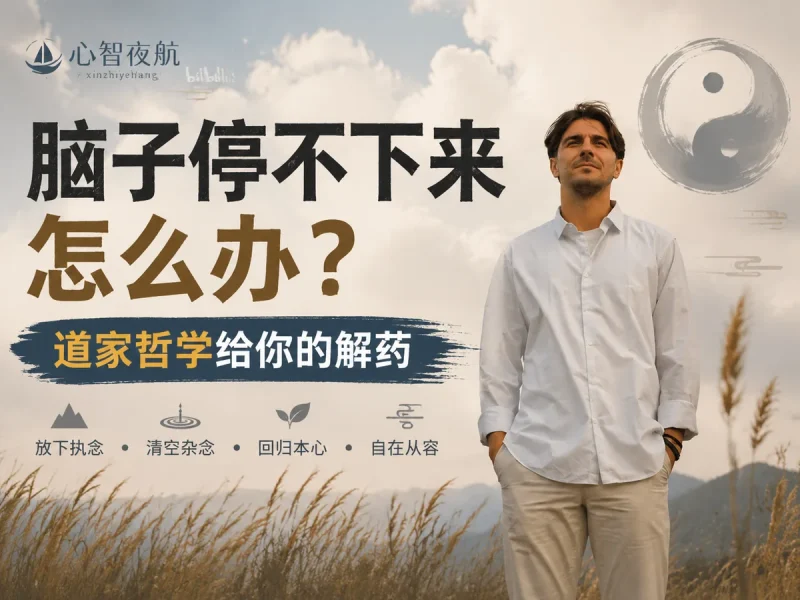
当脑子被知识、判断、期待和外界评价填满时,人容易陷入忧虑、冲突与反复思考。本课程借助老子、列子与庄子的道家思想,讨论“空无”如何为心灵留出空间。
课程从车轮中心的孔、陶罐的空腔、房屋与地铁所需的空间出发,说明“无”并非毫无价值,而是让事物得以发挥作用的条件。对应到内心,暂时放下固有概念、成见与强求,能够帮助人保持开放,更直接地感知现实。
你将了解
- 为什么过度执着于知识、信念和判断,可能加重忧虑与冲突。
- 如何理解道家所说的“虚”与“空无”,以及它与现代反智主义的区别。
- 名声、财富、赞美、否定和得失,如何让人受困于外界评价。
- 庄子“心斋”所强调的放下结果、野心、自我意识与分别判断。
- 为什么在没有利害牵引时,人往往更能自然发挥;而欲望与焦虑会干扰表现。
- 如何以更开放的状态观察现实,并在不强求时等待灵感自然出现。
视频文稿
选择适合你的阅读版本
端着空杯,总比端着满溢的杯子轻松。老子曾说,我们常常意识不到空无有多么重要。或许是因为我们本能地看重'有',而非'无'。我们往往更珍视声音而非寂静,更珍视生命而非死亡,更珍视确定性而非未知。同样,比起宁静、沉默与存在本身,我们更乐于填满思绪、表达想法、保持忙碌。
对现代人而言,空无,不就是一个需要填补的缺陷吗?
但古代的道家,却对空无有着截然不同的看法。他们认为,空无本身就具有价值。事实上,他们将其视为生命中最根本的原则之一,我们不应回避它,而应主动去修养它。
古代典籍中提供了诸多例证,阐述空无的重要性,以及它如何能深刻地滋养我们的生命。本视频基于古代道家哲学,探讨了空无这一被低估的力量。
我叫斯蒂芬。如果你喜欢我的作品,可以在 Substack 上订阅我的通讯。也可以在 Patreon 上支持我。我的书也可以在亚马逊上买到。谢谢,希望你喜欢这个视频。
想象一下,漫步在一座庞大、美丽、繁华的城市,比如巴黎、罗马,或者新加坡。既然道家思想在新加坡底蕴浓厚看来是我们进行思想实验的合适地点。现在,假设你正在新加坡漫步。你看到了什么?你看到远处的摩天大楼,左边是一座印度教寺庙,右边是一家投币式洗衣店,正前方是一个地铁站。
你看到周围人来人往,绿树花草装点着人行道。还有汽车穿梭在干净得惊人的街道上。新加坡值得一看的东西很多。这是个多姿多彩、多元融合的地方。
但当你走在这座城市的街道上,你是否留意到那些‘不在场’的事物?你是否意识到,你所见的一切,其周遭与内在的空无?这些问题或许显得奇怪,但道家认为,空无与事物的物理形态一样,同样是其不可或缺的一部分。事实上,往往是空无使事物变得有用。
三十根辐条组合成一个车轮,但正是中心的孔,才让轮子能够转动。我们将陶土塑造成罐子,但正是其内部的空无,才让器皿得以有用。正如《道德经》所言。
细想之下,若无空无,我们所观察到的世间万物都无法真正存在,正如古希腊哲学家巴门尼德早已指出的那样。我们需要空间。我们需要它来运动,来分隔物体与生灵,来使万物具备功能。
就拿房子来说吧。我们往往非常看重建造房屋的材料,比如混凝土墙、木门或是隔音窗。我们希望地基坚固,屋顶结实耐用。但正如老子所言,不正是其内部的'空无',才让它适宜居住吗?
当然,我们用材料把房子建起来,但我们真正使用的,主要是材料之间的'空无'。这个道理,在新加坡这样的城市里也适用。正是地铁站内的'空无',才让我们能够进入、走到站台、登上列车。正因为有空无,这些列车才能在隧道中运行。所以,空无对我们的生存至关重要。
好,这个观点很有意思,但它如何能帮助我们应对日常生活呢?古代道家典籍指出,空无的意义并不仅限于事物的实用功能。它也适用于我们内心的活动与感受。
从道家的视角来看,许多人的问题在于,他们的心灵实在太满了。让我们来看看。
绝学弃智便无忧虑。认同与反对,真有那么不同吗?善与恶,真有那么遥远吗?他人所惧,我亦必惧吗?此等妄念,无休无止。
在作家兼气功教师索拉拉·陶勒的译本中,老子是在鼓吹彻底的反智主义吗?并非如此。至少,不是我们今天常见的那种反智主义即人们拒绝体制化的知识体系结果却用网红口号、简单化的世界观以及缺乏证据、只会加固个人偏见的阴谋论叙事取而代之。
这也是一种智识学习,只不过是一种相当糟糕的学习。不过,老子似乎确实对智识追求抱有戒心。获取知识,让自己沉浸在无数的类别、观念和理论之中,固然轻松有趣,但这些也会占据我们的心神。它们可能导致忧虑和过度思虑。
我们会变得执着于各种区分和概念框架,而现实本身,可能远比我们的概念所暗示的更为流动不居。久而久之,我们可能会开始将自己的理解误当作现实本身。我们会对何为善恶、对错形成强烈的看法,判断谁该畏惧、谁该欢迎。
不可避免地,这些信念体系会与他人的信念发生冲突,这在当今西方的许多地方都能观察到。当我们的头脑充满成见、封闭起来时,就几乎没有容纳新见解或不同视角的空间了。
但如果我们,哪怕是暂时地,清空头脑中既有的信念呢?如果我们只是放下已知的一切呢?如果我们先清空内心,不急于用既有信念或假设去过滤,而是直接观察现实,会怎样?
从道家的角度来看这种空间会带来一种开放感,或者说‘虚’这是一种接纳的心态,使我们能更清晰地感知现实,而不被先前的解读过分束缚。
庄子说:“虚室生白。”就像一个充满光亮的空房间一颗虚空的心,也更能接纳现实和直接的体验。
心灵的空无还有另一面,与其说是知识的匮乏,不如说是摒弃了各种分别思虑。我们总爱用问题塞满头脑,不停地寻求解决方案、制定计划、反复盘算,有时甚至陷入一种重复循环。于是心灵变得拥挤而紧绷,我们越是试图强求一个好点子,似乎就越难成功。
而我们许多绝妙的想法,往往在我们不再拼命强求时,才浮现出来。它们可能在清晨散步或淋浴时不期而至。它们总在我们心灵宽广、有足够空间让想法自然浮现的时候出现。
往往正是在这些时刻,心灵的'空无'让想法得以浮现,而非靠'分别思虑'去强行催生它们。
但根据古代道家典籍所言,心灵的'空无'还有另一个层面能让我们受益,我们现在就来探讨。
有人曾问道家哲学家列子,为何他如此重视'空无'。他是这样回答的。
大多数人都喜欢被赞美。当他们的成就得到认可时,他们会感觉良好。然而,我觉得,如果我们内心空无执念,不被外界的认可、赞许或否定所束缚,会活得更自在。从长远来看我们操心的事也会更少。正因如此,我珍视'空无'。
列子也洞见了这一点,许多灵性传统和哲学家亦如是观。一颗汲汲于世俗挂虑——即原文所说的'名利'——的心,并非安乐之心。它充满忧虑,滋生痛苦。
而且我们得承认,追求名声往往意味着要不停地取悦他人。我们的一言一行,最终都是为了求得他人的赞许。赢得赞美通常要费尽心力,而多数人又希望这赞美源源不断。他们害怕失去青睐。于是,他们不断浇灌这株赞美之苗,希望人们能继续欣赏他们。就这样,他们为自己筑起了一座牢笼,一座由他人的认可、赞许与否定所构成的牢笼。
更糟的是,他人的看法并非他们所能控制,即便他们百般努力,最终仍可能失去他人的青睐。因此,恐惧总是挥之不去。害怕自己苦心经营起来的认可与赞同会顷刻间失去,而我们知道,这完全可能发生。
一颗汲汲于利的心,也会让人陷入持续的忧虑与焦虑。当我们主要透过得失的透镜看待生活,我们的福祉便与无法掌控的外部环境绑定在一起。成功带来满足,而失败则带来失望。于是我们终日追逐利益,提防损失,因为我们的幸福全系于此。
这常常是一种充满压力的活法。所以,列子认为,如果人们能将这些执着从心中清空,他们的状态会更好。他声称,对名利的追求终究是毫无价值的。而我们所谓的成就,是如此依赖于外部环境,以至于我们或许该自问:为此居功,并四处炫耀,这真的公平吗?列子说,不如放下它们,让心归于平静。
而通过这样做,我们甚至可能达到道家空无的终极境界,这我们接下来会探讨。
如果你能清空心中所有思绪,你的心便会沉浸在宁静与安详之中。观照世间万物的运作并静思其复归本源。当我们领悟了空无的价值,平息了内心的纷扰,并放下了对名利的执念我们便可践行庄子所说的“心斋”。
在古代中国思想中,心被视为思维与情感的中心正因如此,庄子的这个术语常被译为“心斋”(fasting of the heart)或“心斋”(fasting of the mind)。在中文里,它被称为“心斋”(Xinjiai)。
我们现代人的生活,通常都围绕着获取——获取知识、获取经验、获取金钱,或是获取权力。而'心斋'的理念,则更多是关于舍弃或遗忘。与其试图获取更多,我们卸下肩头的重负,直到只剩下空无。
在《庄子》中,孔子这样描述这个过程:勿听之以耳,听之以心。不,勿听之以心,听之以气。耳止于听。
心智的活动,止于分别认知。但精神是空无的,静待万物。道,唯集于空无。空无,即是心斋。引文结束。
心斋不仅仅是放下对成功或名誉的欲望。它意味着放下对结果的执着、信念、野心,甚至我们的自我意识。与其不断评判事物的好坏对错,我们向这个不断变化的世界保持开放。这种心灵的澄明,可以说,能让人自发地行动。我们可以观察正在发生的一切,不受先入之见、期望或欲望的干扰。并对其做出回应。
正是这种开放,这种空无,让我们得以更直接地体验现实。这甚至能在某些情境下提升我们的表现。
我们可以在《庄子》中找到这样一个例子。书中讲到一位技艺高超的射手,在无关利害时,他能轻松射中目标。但当他为奖品角逐时,求胜的念头便干扰了他的射术。他的内心充满了欲望、焦虑和对未来的思虑。而在此之前,他心境澄澈,
让他射箭时轻松自如。从道家思想的角度看,心斋让我们更接近道,这正是道家思想的核心所在。道无法通过概念或理性分析来完全把握。然而它无处不在,是万物的根基。
当我们放下对观念、概念和分别思虑的执着,我们便能更和谐地融入自身所属的宏大进程。我们的道家学者李冲她在书中写道,要与宇宙的呼吸合而为一。
如果你对道家思想感兴趣我受到古代道家经典的启发,将我的一些随想汇集成书,书名为《道家思想与内心平静》。感谢观看。
It is easier to carry an empty cup than one that is filled to the brim. Lao Tzu We often fail to realize how essential emptiness is. Perhaps it is because we instinctively value something over nothing. We tend to cherish sound more than silence, life more than death, and certainty more than the unknown. Likewise, We often prefer filling our minds, expressing our thoughts, and staying busy, over stillness, silence, and simply being.
To the modern human what's emptiness but a deficiency to be filled?
But the ancient Taoists saw emptiness very differently. They believed emptiness has inherent value. In fact, they saw it as one of the most important principles of life which shouldn't be avoided, but cultivated.
The ancient texts provide various examples of how emptiness is important and how it can benefit our lives in profound ways. This video explores the underrated power of emptiness, based on ancient Taoist philosophy.
My name is Stefan. If you enjoy my work you can subscribe to my newsletter on Substack. You can also support me on Patreon and my books are available on Amazon. Thank you, and I hope you'll enjoy this video.
Imagine walking through a large, beautiful, bustling city like Paris, Rome, or perhaps Singapore. Since Taoism is very much present in Singapore it seems like a fitting place for our thought experiment. So, you're walking through Singapore. What do you see? You see skyscrapers in the distance, a Hindu temple on your left, a coin laundry on your right, and a subway station in front of you.
You see people walking around trees and plants decorating the sidewalks and cars driving on the insanely clean street. There's much to see in Singapore. It's a colorful, diverse place.
But as you walk through its streets are you paying attention to what isn't there? Are you aware of the spaces around and within everything you see? These questions may seem strange but the Taoists argued that emptiness is as much part of things as their physical form. In fact, it is often emptiness that makes them useful.
Thirty spokes are joined together in a wheel but it is the center hole that allows the wheel to function. We mold clay into a pot but it is the emptiness inside that makes the vessel useful. according to the Tao Te Ching.
When we think about it, without emptiness none of the things we observe in our world can really exist as the ancient Greek philosopher Parmenides already suggested. We need empty space. We need it for movement, for separation between objects and beings for making anything functional.
Take a house, for example. We may put great emphasis on the materials used to build it, such as its concrete walls, wooden doors, or soundproof windows. We want the foundation to be strong the roof to be durable. But as Lao Tzu suggested isn't the emptiness inside that makes it livable?
Sure, we use the materials to put the house together but it's mainly the empty spaces between them that we use. The same goes for anything in a city like Singapore. It's the empty space within subway stations that allows us to enter, walk to the platforms, and board trains. It allows these trains to move within the tunnels in the first place. So emptiness turns out to be highly essential for our existence.
Okay, that's a nice observation but how could this notion help us in our daily affairs? The ancient Taoist texts show that the significance of emptiness isn't limited to the mere functionality of objects in the world. It also applies to the workings of our minds and how we feel.
From a Taoist perspective the problem with many people is that their minds are simply too full. Let's take a look.
Give up intellectual learning and you will have no worries. Agreement and disagreement, are they really so different? Good and evil, are they really so far apart? What others fear, must I also fear? This nonsense is unending.
In this translation by author and Qigong teacher Solala Tauler, is Lao Tzu advocating for full-blown anti-intellectualism? Not really. At least, not the kind of anti-intellectualism we often see today where people reject institutional systems of knowledge only to replace them with influencer slogans, simplistic worldviews and conspiracy narratives that lack evidence and reinforce personal biases.
That, too, is a form of intellectual learning, but a pretty poor one. Lao Tzu does seem wary of intellectual pursuits, though. Gaining knowledge and immersing ourselves in countless categories, ideas and theories is all fun and games but these also occupy our minds. They can lead to worry and overthinking.
We become attached to distinctions and conceptual frameworks while reality itself may be far more fluid than our concepts suggest. Over time, we may begin to mistake our interpretations for reality itself. We develop strong opinions about what is good and evil, right and wrong whom we should fear and whom we should welcome.
Inevitably, these belief systems clash with those of others something we can observe in many parts of the West today. When our minds are full and closed off there's little room for new insights or different perspectives.
But what if, even just temporarily we would empty our minds of existing beliefs? What if we just let go of what we know? What if we create space to see reality without immediately filtering it through the lens of what we already believe or assume to be true?
From a Taoist perspective this space creates a sense of openness or Xu a receptive state of mind that allows us to perceive reality more clearly, without being overly constrained by prior interpretations.
The empty apartment is filled with light through it, said Zhuangzi. Like an empty room illuminated by light an empty mind becomes more receptive to reality and direct experience.
There's another aspect to emptiness of mind, not so much the absence of knowledge, but the absence of all kinds of discursive activity. We tend to fill our minds with problems, seeking solutions, planning, plotting, sometimes in a very repetitive manner. Our minds become crowded and tense and the more we try to force a good idea the less we seem to succeed.
Many of our best ideas emerge when we stop trying so hard. They arrive during a morning walk or in the shower. They come up when our minds are spacious when there's room for ideas to appear naturally.
It is often the emptiness of the mind in such moments that allow ideas to arise rather than discursive thought trying to force them into existence.
But there's also another dimension of mental emptiness that could benefit us according to the ancient Taoist text which we'll explore right now.
Someone asked the Taoist philosopher Li Zi why he valued emptiness. He answered as follows.
Most people like to be praised. They feel good when their accomplishments are acknowledged. However, I feel we would be better off if we were empty of attachments, and not imprisoned by recognition, approval, and disapproval. In the long run we would have fewer things to worry about. That's why I value emptiness.
Liuzi saw what many spiritual traditions and philosophers have observed as well. A mind preoccupied with worldly concerns, described in the original text as fame and profit, or mingli, is not a very pleasant mind. It's a mind full of worry a mind that generates suffering.
And let's face it, pursuing fame often means constantly trying to please an audience. We end up doing and saying things with other people's approval in mind. Obtaining praise usually takes a lot of effort and most people want to keep their praise coming. They fear falling out of favor. So, they keep watering it hoping people will continue to adore them. And so, they have built themselves a prison, one based on recognition, approval, and disapproval.
What's even worse is that people's opinions aren't in their control and they might fall out of favor anyway, despite their efforts. So, there's always the fear that they will lose the recognition and approval they spent so much time building, which, as we know, could happen in a heartbeat.
A mind occupied with profit is another path to ongoing worry and anxiety. When we view life primarily through the lens of gain and loss, our well-being becomes tied to circumstances beyond our control. Success leads to satisfaction while failure brings disappointment. And so we spend our days pursuing profit and guarding against loss as our happiness depends on it.
Often, that's a stressful way to live. So, Li Zi felt people would be better off if their minds were empty of such attachments. Pursuits of fame and wealth are worthless anyway, he claimed. And our so-called accomplishments rely so heavily on external circumstances that we might ask ourselves whether taking credit for them and parading them around is even fair. Better just let them go and quiet down, says Lietze.
And by doing so we might even reach the ultimate form of Taoist emptiness which we'll explore next.
If you can empty your mind of all thoughts your heart will embrace the tranquility of peace. Watch the workings of all of creation but contemplate their return to the source. When we have contemplated the value of emptiness, calmed our minds, and let go of desires for fame and profit we could engage in the process Zhuangzi called the fasting of the heart.
In ancient Chinese thought, the heart , was seen as the center of both thinking and feeling which is why Zhuangzi's term is often translated as either fasting of the heart or fasting of the mind. In Chinese, it's called Xinjiai.
When our modern lives usually revolve around gaining, such as gaining knowledge, gaining experiences, gaining money, or gaining power the idea of fasting of the heart is more about losing or forgetting. Instead of trying to get more we take the weight off our shoulders until there's nothing left but emptiness.
In the Zhuangzi, Confucius describes the process as follows. Don't listen with your ears listen with your mind. No, don't listen with your mind but listen with your spirit. Listening stops with the ears.
The mind stops with recognition. But spirit is empty and waits on all things. The way gathers in emptiness alone. Emptiness is the fasting of the mind. End quote.
The fasting of the heart is more than letting go of desires for success or reputation. It means letting go of the outcomes, beliefs, ambitions, and even our sense of self. Rather than constantly judging things as good or bad, right or wrong We remain open to a world that is always changing. This kind of mental clarity, so to speak, allows for spontaneous action. We can observe what is happening without distortion from preconceptions, expectations, or desires and respond to what arises.
It is an openness, an emptiness that allows us to experience reality more directly. And this may even enhance our performance in certain situations.
We can find an example of this in the Zhuangzi which tells about a skilled archer who could easily hit the target when nothing was at stake. But when he competed for a prize his thoughts about winning interfered with his ability to shoot. His mind was filled with desire, anxiety, and thoughts about the future. Whereas before, it was clear
allowing him to shoot with ease. From the Taoist perspective the fasting of the mind brings us closer to the Tao which lies at the very heart of Taoism. The Tao cannot be fully understood through concepts or intellectual analysis. Yet it is ever-present and underlies all things.
As we let go of our attachments to ideas, concepts, and discursive thought we become more attuned to the greater process of which we are a part. Our asynologist, Wuyi Li Chong wrote in her book about Taoist philosophy, one with the breathing of the cosmos.
If you're interested in Taoist philosophy I've compiled a book of my ramblings inspired by ancient Taoist texts, titled Taoism for Inner Peace. Thank you for watching.
It is easier to carry an empty cup than one that is filled to the brim. Lao Tzu We often fail to realize how essential emptiness is. Perhaps it is because we instinctively value something over nothing. We tend to cherish sound more than silence, life more than death, and certainty more than the unknown. Likewise, We often prefer filling our minds, expressing our thoughts, and staying busy, over stillness, silence, and simply being.
端着空杯,总比端着满溢的杯子轻松。老子曾说,我们常常意识不到空无有多么重要。或许是因为我们本能地看重'有',而非'无'。我们往往更珍视声音而非寂静,更珍视生命而非死亡,更珍视确定性而非未知。同样,比起宁静、沉默与存在本身,我们更乐于填满思绪、表达想法、保持忙碌。
To the modern human what's emptiness but a deficiency to be filled?
对现代人而言,空无,不就是一个需要填补的缺陷吗?
But the ancient Taoists saw emptiness very differently. They believed emptiness has inherent value. In fact, they saw it as one of the most important principles of life which shouldn't be avoided, but cultivated.
但古代的道家,却对空无有着截然不同的看法。他们认为,空无本身就具有价值。事实上,他们将其视为生命中最根本的原则之一,我们不应回避它,而应主动去修养它。
The ancient texts provide various examples of how emptiness is important and how it can benefit our lives in profound ways. This video explores the underrated power of emptiness, based on ancient Taoist philosophy.
古代典籍中提供了诸多例证,阐述空无的重要性,以及它如何能深刻地滋养我们的生命。本视频基于古代道家哲学,探讨了空无这一被低估的力量。
My name is Stefan. If you enjoy my work you can subscribe to my newsletter on Substack. You can also support me on Patreon and my books are available on Amazon. Thank you, and I hope you'll enjoy this video.
我叫斯蒂芬。如果你喜欢我的作品,可以在 Substack 上订阅我的通讯。也可以在 Patreon 上支持我。我的书也可以在亚马逊上买到。谢谢,希望你喜欢这个视频。
Imagine walking through a large, beautiful, bustling city like Paris, Rome, or perhaps Singapore. Since Taoism is very much present in Singapore it seems like a fitting place for our thought experiment. So, you're walking through Singapore. What do you see? You see skyscrapers in the distance, a Hindu temple on your left, a coin laundry on your right, and a subway station in front of you.
想象一下,漫步在一座庞大、美丽、繁华的城市,比如巴黎、罗马,或者新加坡。既然道家思想在新加坡底蕴浓厚看来是我们进行思想实验的合适地点。现在,假设你正在新加坡漫步。你看到了什么?你看到远处的摩天大楼,左边是一座印度教寺庙,右边是一家投币式洗衣店,正前方是一个地铁站。
You see people walking around trees and plants decorating the sidewalks and cars driving on the insanely clean street. There's much to see in Singapore. It's a colorful, diverse place.
你看到周围人来人往,绿树花草装点着人行道。还有汽车穿梭在干净得惊人的街道上。新加坡值得一看的东西很多。这是个多姿多彩、多元融合的地方。
But as you walk through its streets are you paying attention to what isn't there? Are you aware of the spaces around and within everything you see? These questions may seem strange but the Taoists argued that emptiness is as much part of things as their physical form. In fact, it is often emptiness that makes them useful.
但当你走在这座城市的街道上,你是否留意到那些‘不在场’的事物?你是否意识到,你所见的一切,其周遭与内在的空无?这些问题或许显得奇怪,但道家认为,空无与事物的物理形态一样,同样是其不可或缺的一部分。事实上,往往是空无使事物变得有用。
Thirty spokes are joined together in a wheel but it is the center hole that allows the wheel to function. We mold clay into a pot but it is the emptiness inside that makes the vessel useful. according to the Tao Te Ching.
三十根辐条组合成一个车轮,但正是中心的孔,才让轮子能够转动。我们将陶土塑造成罐子,但正是其内部的空无,才让器皿得以有用。正如《道德经》所言。
When we think about it, without emptiness none of the things we observe in our world can really exist as the ancient Greek philosopher Parmenides already suggested. We need empty space. We need it for movement, for separation between objects and beings for making anything functional.
细想之下,若无空无,我们所观察到的世间万物都无法真正存在,正如古希腊哲学家巴门尼德早已指出的那样。我们需要空间。我们需要它来运动,来分隔物体与生灵,来使万物具备功能。
Take a house, for example. We may put great emphasis on the materials used to build it, such as its concrete walls, wooden doors, or soundproof windows. We want the foundation to be strong the roof to be durable. But as Lao Tzu suggested isn't the emptiness inside that makes it livable?
就拿房子来说吧。我们往往非常看重建造房屋的材料,比如混凝土墙、木门或是隔音窗。我们希望地基坚固,屋顶结实耐用。但正如老子所言,不正是其内部的'空无',才让它适宜居住吗?
Sure, we use the materials to put the house together but it's mainly the empty spaces between them that we use. The same goes for anything in a city like Singapore. It's the empty space within subway stations that allows us to enter, walk to the platforms, and board trains. It allows these trains to move within the tunnels in the first place. So emptiness turns out to be highly essential for our existence.
当然,我们用材料把房子建起来,但我们真正使用的,主要是材料之间的'空无'。这个道理,在新加坡这样的城市里也适用。正是地铁站内的'空无',才让我们能够进入、走到站台、登上列车。正因为有空无,这些列车才能在隧道中运行。所以,空无对我们的生存至关重要。
Okay, that's a nice observation but how could this notion help us in our daily affairs? The ancient Taoist texts show that the significance of emptiness isn't limited to the mere functionality of objects in the world. It also applies to the workings of our minds and how we feel.
好,这个观点很有意思,但它如何能帮助我们应对日常生活呢?古代道家典籍指出,空无的意义并不仅限于事物的实用功能。它也适用于我们内心的活动与感受。
From a Taoist perspective the problem with many people is that their minds are simply too full. Let's take a look.
从道家的视角来看,许多人的问题在于,他们的心灵实在太满了。让我们来看看。
Give up intellectual learning and you will have no worries. Agreement and disagreement, are they really so different? Good and evil, are they really so far apart? What others fear, must I also fear? This nonsense is unending.
绝学弃智便无忧虑。认同与反对,真有那么不同吗?善与恶,真有那么遥远吗?他人所惧,我亦必惧吗?此等妄念,无休无止。
In this translation by author and Qigong teacher Solala Tauler, is Lao Tzu advocating for full-blown anti-intellectualism? Not really. At least, not the kind of anti-intellectualism we often see today where people reject institutional systems of knowledge only to replace them with influencer slogans, simplistic worldviews and conspiracy narratives that lack evidence and reinforce personal biases.
在作家兼气功教师索拉拉·陶勒的译本中,老子是在鼓吹彻底的反智主义吗?并非如此。至少,不是我们今天常见的那种反智主义即人们拒绝体制化的知识体系结果却用网红口号、简单化的世界观以及缺乏证据、只会加固个人偏见的阴谋论叙事取而代之。
That, too, is a form of intellectual learning, but a pretty poor one. Lao Tzu does seem wary of intellectual pursuits, though. Gaining knowledge and immersing ourselves in countless categories, ideas and theories is all fun and games but these also occupy our minds. They can lead to worry and overthinking.
这也是一种智识学习,只不过是一种相当糟糕的学习。不过,老子似乎确实对智识追求抱有戒心。获取知识,让自己沉浸在无数的类别、观念和理论之中,固然轻松有趣,但这些也会占据我们的心神。它们可能导致忧虑和过度思虑。
We become attached to distinctions and conceptual frameworks while reality itself may be far more fluid than our concepts suggest. Over time, we may begin to mistake our interpretations for reality itself. We develop strong opinions about what is good and evil, right and wrong whom we should fear and whom we should welcome.
我们会变得执着于各种区分和概念框架,而现实本身,可能远比我们的概念所暗示的更为流动不居。久而久之,我们可能会开始将自己的理解误当作现实本身。我们会对何为善恶、对错形成强烈的看法,判断谁该畏惧、谁该欢迎。
Inevitably, these belief systems clash with those of others something we can observe in many parts of the West today. When our minds are full and closed off there's little room for new insights or different perspectives.
不可避免地,这些信念体系会与他人的信念发生冲突,这在当今西方的许多地方都能观察到。当我们的头脑充满成见、封闭起来时,就几乎没有容纳新见解或不同视角的空间了。
But what if, even just temporarily we would empty our minds of existing beliefs? What if we just let go of what we know? What if we create space to see reality without immediately filtering it through the lens of what we already believe or assume to be true?
但如果我们,哪怕是暂时地,清空头脑中既有的信念呢?如果我们只是放下已知的一切呢?如果我们先清空内心,不急于用既有信念或假设去过滤,而是直接观察现实,会怎样?
From a Taoist perspective this space creates a sense of openness or Xu a receptive state of mind that allows us to perceive reality more clearly, without being overly constrained by prior interpretations.
从道家的角度来看这种空间会带来一种开放感,或者说‘虚’这是一种接纳的心态,使我们能更清晰地感知现实,而不被先前的解读过分束缚。
The empty apartment is filled with light through it, said Zhuangzi. Like an empty room illuminated by light an empty mind becomes more receptive to reality and direct experience.
庄子说:“虚室生白。”就像一个充满光亮的空房间一颗虚空的心,也更能接纳现实和直接的体验。
There's another aspect to emptiness of mind, not so much the absence of knowledge, but the absence of all kinds of discursive activity. We tend to fill our minds with problems, seeking solutions, planning, plotting, sometimes in a very repetitive manner. Our minds become crowded and tense and the more we try to force a good idea the less we seem to succeed.
心灵的空无还有另一面,与其说是知识的匮乏,不如说是摒弃了各种分别思虑。我们总爱用问题塞满头脑,不停地寻求解决方案、制定计划、反复盘算,有时甚至陷入一种重复循环。于是心灵变得拥挤而紧绷,我们越是试图强求一个好点子,似乎就越难成功。
Many of our best ideas emerge when we stop trying so hard. They arrive during a morning walk or in the shower. They come up when our minds are spacious when there's room for ideas to appear naturally.
而我们许多绝妙的想法,往往在我们不再拼命强求时,才浮现出来。它们可能在清晨散步或淋浴时不期而至。它们总在我们心灵宽广、有足够空间让想法自然浮现的时候出现。
It is often the emptiness of the mind in such moments that allow ideas to arise rather than discursive thought trying to force them into existence.
往往正是在这些时刻,心灵的'空无'让想法得以浮现,而非靠'分别思虑'去强行催生它们。
But there's also another dimension of mental emptiness that could benefit us according to the ancient Taoist text which we'll explore right now.
但根据古代道家典籍所言,心灵的'空无'还有另一个层面能让我们受益,我们现在就来探讨。
Someone asked the Taoist philosopher Li Zi why he valued emptiness. He answered as follows.
有人曾问道家哲学家列子,为何他如此重视'空无'。他是这样回答的。
Most people like to be praised. They feel good when their accomplishments are acknowledged. However, I feel we would be better off if we were empty of attachments, and not imprisoned by recognition, approval, and disapproval. In the long run we would have fewer things to worry about. That's why I value emptiness.
大多数人都喜欢被赞美。当他们的成就得到认可时,他们会感觉良好。然而,我觉得,如果我们内心空无执念,不被外界的认可、赞许或否定所束缚,会活得更自在。从长远来看我们操心的事也会更少。正因如此,我珍视'空无'。
Liuzi saw what many spiritual traditions and philosophers have observed as well. A mind preoccupied with worldly concerns, described in the original text as fame and profit, or mingli, is not a very pleasant mind. It's a mind full of worry a mind that generates suffering.
列子也洞见了这一点,许多灵性传统和哲学家亦如是观。一颗汲汲于世俗挂虑——即原文所说的'名利'——的心,并非安乐之心。它充满忧虑,滋生痛苦。
And let's face it, pursuing fame often means constantly trying to please an audience. We end up doing and saying things with other people's approval in mind. Obtaining praise usually takes a lot of effort and most people want to keep their praise coming. They fear falling out of favor. So, they keep watering it hoping people will continue to adore them. And so, they have built themselves a prison, one based on recognition, approval, and disapproval.
而且我们得承认,追求名声往往意味着要不停地取悦他人。我们的一言一行,最终都是为了求得他人的赞许。赢得赞美通常要费尽心力,而多数人又希望这赞美源源不断。他们害怕失去青睐。于是,他们不断浇灌这株赞美之苗,希望人们能继续欣赏他们。就这样,他们为自己筑起了一座牢笼,一座由他人的认可、赞许与否定所构成的牢笼。
What's even worse is that people's opinions aren't in their control and they might fall out of favor anyway, despite their efforts. So, there's always the fear that they will lose the recognition and approval they spent so much time building, which, as we know, could happen in a heartbeat.
更糟的是,他人的看法并非他们所能控制,即便他们百般努力,最终仍可能失去他人的青睐。因此,恐惧总是挥之不去。害怕自己苦心经营起来的认可与赞同会顷刻间失去,而我们知道,这完全可能发生。
A mind occupied with profit is another path to ongoing worry and anxiety. When we view life primarily through the lens of gain and loss, our well-being becomes tied to circumstances beyond our control. Success leads to satisfaction while failure brings disappointment. And so we spend our days pursuing profit and guarding against loss as our happiness depends on it.
一颗汲汲于利的心,也会让人陷入持续的忧虑与焦虑。当我们主要透过得失的透镜看待生活,我们的福祉便与无法掌控的外部环境绑定在一起。成功带来满足,而失败则带来失望。于是我们终日追逐利益,提防损失,因为我们的幸福全系于此。
Often, that's a stressful way to live. So, Li Zi felt people would be better off if their minds were empty of such attachments. Pursuits of fame and wealth are worthless anyway, he claimed. And our so-called accomplishments rely so heavily on external circumstances that we might ask ourselves whether taking credit for them and parading them around is even fair. Better just let them go and quiet down, says Lietze.
这常常是一种充满压力的活法。所以,列子认为,如果人们能将这些执着从心中清空,他们的状态会更好。他声称,对名利的追求终究是毫无价值的。而我们所谓的成就,是如此依赖于外部环境,以至于我们或许该自问:为此居功,并四处炫耀,这真的公平吗?列子说,不如放下它们,让心归于平静。
And by doing so we might even reach the ultimate form of Taoist emptiness which we'll explore next.
而通过这样做,我们甚至可能达到道家空无的终极境界,这我们接下来会探讨。
If you can empty your mind of all thoughts your heart will embrace the tranquility of peace. Watch the workings of all of creation but contemplate their return to the source. When we have contemplated the value of emptiness, calmed our minds, and let go of desires for fame and profit we could engage in the process Zhuangzi called the fasting of the heart.
如果你能清空心中所有思绪,你的心便会沉浸在宁静与安详之中。观照世间万物的运作并静思其复归本源。当我们领悟了空无的价值,平息了内心的纷扰,并放下了对名利的执念我们便可践行庄子所说的“心斋”。
In ancient Chinese thought, the heart , was seen as the center of both thinking and feeling which is why Zhuangzi's term is often translated as either fasting of the heart or fasting of the mind. In Chinese, it's called Xinjiai.
在古代中国思想中,心被视为思维与情感的中心正因如此,庄子的这个术语常被译为“心斋”(fasting of the heart)或“心斋”(fasting of the mind)。在中文里,它被称为“心斋”(Xinjiai)。
When our modern lives usually revolve around gaining, such as gaining knowledge, gaining experiences, gaining money, or gaining power the idea of fasting of the heart is more about losing or forgetting. Instead of trying to get more we take the weight off our shoulders until there's nothing left but emptiness.
我们现代人的生活,通常都围绕着获取——获取知识、获取经验、获取金钱,或是获取权力。而'心斋'的理念,则更多是关于舍弃或遗忘。与其试图获取更多,我们卸下肩头的重负,直到只剩下空无。
In the Zhuangzi, Confucius describes the process as follows. Don't listen with your ears listen with your mind. No, don't listen with your mind but listen with your spirit. Listening stops with the ears.
在《庄子》中,孔子这样描述这个过程:勿听之以耳,听之以心。不,勿听之以心,听之以气。耳止于听。
The mind stops with recognition. But spirit is empty and waits on all things. The way gathers in emptiness alone. Emptiness is the fasting of the mind. End quote.
心智的活动,止于分别认知。但精神是空无的,静待万物。道,唯集于空无。空无,即是心斋。引文结束。
The fasting of the heart is more than letting go of desires for success or reputation. It means letting go of the outcomes, beliefs, ambitions, and even our sense of self. Rather than constantly judging things as good or bad, right or wrong We remain open to a world that is always changing. This kind of mental clarity, so to speak, allows for spontaneous action. We can observe what is happening without distortion from preconceptions, expectations, or desires and respond to what arises.
心斋不仅仅是放下对成功或名誉的欲望。它意味着放下对结果的执着、信念、野心,甚至我们的自我意识。与其不断评判事物的好坏对错,我们向这个不断变化的世界保持开放。这种心灵的澄明,可以说,能让人自发地行动。我们可以观察正在发生的一切,不受先入之见、期望或欲望的干扰。并对其做出回应。
It is an openness, an emptiness that allows us to experience reality more directly. And this may even enhance our performance in certain situations.
正是这种开放,这种空无,让我们得以更直接地体验现实。这甚至能在某些情境下提升我们的表现。
We can find an example of this in the Zhuangzi which tells about a skilled archer who could easily hit the target when nothing was at stake. But when he competed for a prize his thoughts about winning interfered with his ability to shoot. His mind was filled with desire, anxiety, and thoughts about the future. Whereas before, it was clear
我们可以在《庄子》中找到这样一个例子。书中讲到一位技艺高超的射手,在无关利害时,他能轻松射中目标。但当他为奖品角逐时,求胜的念头便干扰了他的射术。他的内心充满了欲望、焦虑和对未来的思虑。而在此之前,他心境澄澈,
allowing him to shoot with ease. From the Taoist perspective the fasting of the mind brings us closer to the Tao which lies at the very heart of Taoism. The Tao cannot be fully understood through concepts or intellectual analysis. Yet it is ever-present and underlies all things.
让他射箭时轻松自如。从道家思想的角度看,心斋让我们更接近道,这正是道家思想的核心所在。道无法通过概念或理性分析来完全把握。然而它无处不在,是万物的根基。
As we let go of our attachments to ideas, concepts, and discursive thought we become more attuned to the greater process of which we are a part. Our asynologist, Wuyi Li Chong wrote in her book about Taoist philosophy, one with the breathing of the cosmos.
当我们放下对观念、概念和分别思虑的执着,我们便能更和谐地融入自身所属的宏大进程。我们的道家学者李冲她在书中写道,要与宇宙的呼吸合而为一。
If you're interested in Taoist philosophy I've compiled a book of my ramblings inspired by ancient Taoist texts, titled Taoism for Inner Peace. Thank you for watching.
如果你对道家思想感兴趣我受到古代道家经典的启发,将我的一些随想汇集成书,书名为《道家思想与内心平静》。感谢观看。
完整视频资源请在文章下方的会员下载区获取。









暂无评论内容